The heat sink is the bottleneck.
Sub-wavelength geometry that steers heat inside the package, before a cold plate has to move it.
MetaTherm is a thermal semiconductor.
The thermal limit is the new compute limit.
Accelerator power has crossed the kilowatt line at the package and tens of kilowatts at the rack. Cooling consumes a structural fraction of every facility's electricity, and a few degrees at the die surface erase a generation of compute gains. The constraint is no longer transistors. It is heat.
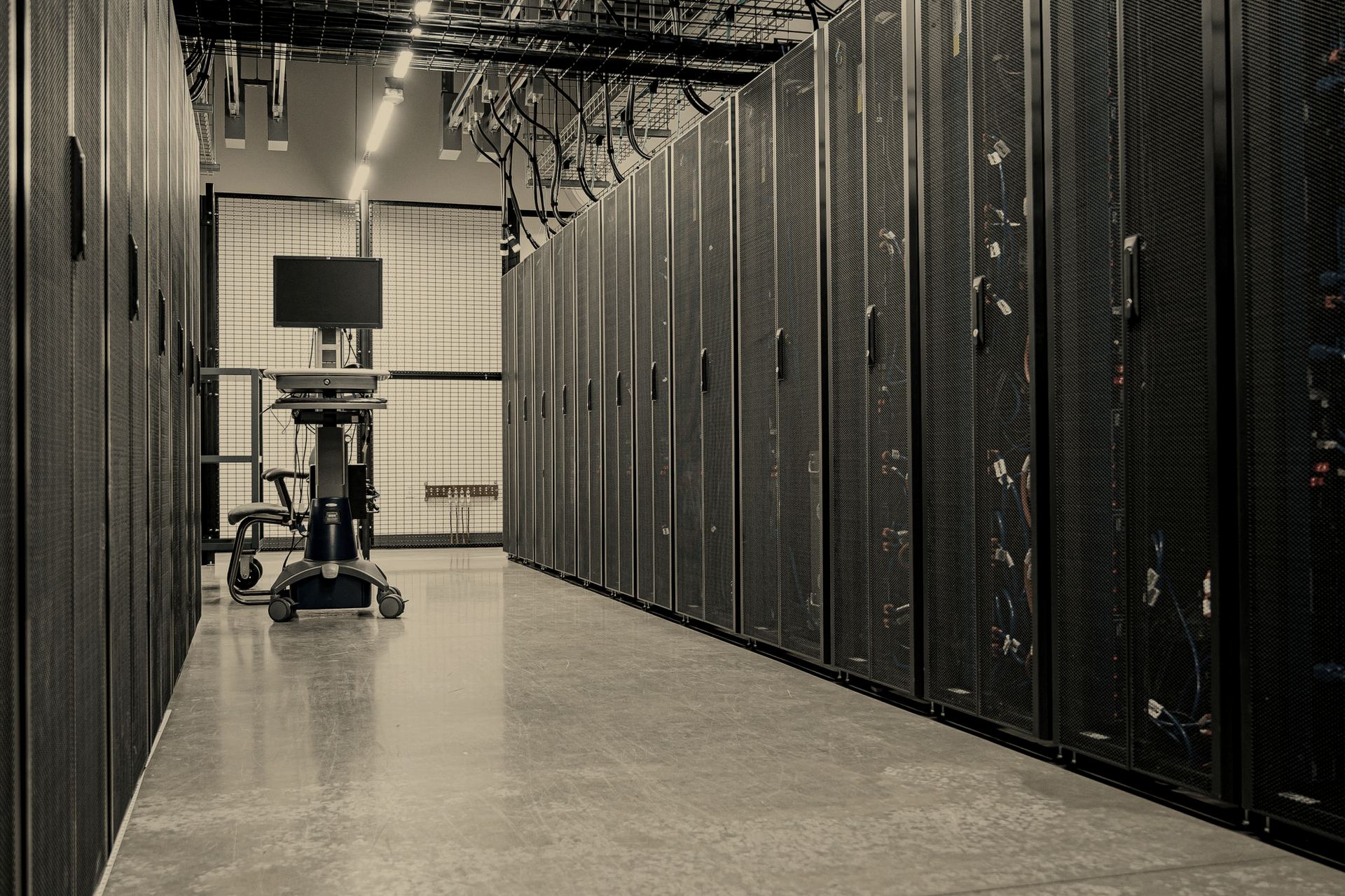
Every wall in this room is doing nothing.
MetaTherm controls where heat goes.
Same room. Same heat source. Different physics at the wall. The result is the difference between a chaotic thermal field and a directed one.
Heat spreads in every direction.
- hotspots
- throttling
- more cooling power
- less usable compute
Heat is directionally controlled.
- thermal bleed contained
- guided to cooling
- lower cooling burden
- more compute per MW
The same wave equation, three orders of magnitude apart.
A phononic crystal opens a band gap in the dispersion relation at f ≈ c/2a, where c is the speed of sound in the medium and ais the lattice constant. The same wave physics holds from the audible range to the THz regime, where thermal phonons carry heat in solids. MetaTherm’s patented geometry engineers that dispersion directly. The mathematics is identical at every scale; only the manufacturing process changes.[1][2]
Resist. Remove.
Direct.
Two strategies have dominated thermal management for a century. MetaTherm is a third: a passive material that steers heat instead of resisting it.
Passive, non-directional. Slows heat transfer in every direction equally. Fiberglass, mineral wool, foam, standard drywall.
Active, mechanical. Circulates coolant to extract heat at the chip, effective and necessary at the component scale. A complement, not a competitor: it solves chip-level extraction while the room-level thermal field is left to ordinary materials.
Passive and directional. The thermal conductivity tensor takes fundamentally different values along different axes: high resistance inward, higher conductance outward. Solid-state, no fluids, no power. Building-scale, hardware-agnostic.
Different problems. Different scales. Multiplicative when combined.
Liquid cooling extracts heat at the chip. MetaTherm manages it at the room. They address different problems at different scales and compound when deployed together, chip-level extraction plus room-level efficiency, working at the same time.
The combined approach could push total PUE toward 1.05 – 1.10, efficiency previously reachable only in purpose-built hyperscale facilities.
- passive
- system-wide
- hardware-agnostic
- retrofit-ready
- synergistic with air or liquid
Measured,
not modeled.
Two assemblies, identical R-15 batt insulation and 3-inch steel studs. Only the facing material differs. COMSOL prediction agrees with physical measurement within 1%.
The 3× R-value at the assembly level is the macroscopic signature of the underlying tensor anisotropy, the same one-way thermal gating that defines the material at every scale.
One physics.
Two form factors.
The same anisotropic geometry scales from sub-millimeter films on accelerator packages to drywall-format panels at the building envelope. Both products derive from the same patent family.
- R-6.05 → R-18.25 measuredAssembly-level, with R-15 batt and 3-in steel studs.
- R-2.3 → R-9.5 panel-onlyDirect gypsum-equivalent comparison.
- Designed for new-construction integrationInstalled in the building envelope at construction. Compatible with retrofit on existing assets.
- 20–30 year operating lifeNo moving parts, no fluids, no maintenance cycle. Building-envelope lifecycle.
- Cost-competitive with standard commercial insulation at scaleManufactured in commodity drywall form factors. Underwrite as an envelope upgrade, not a specialty system.
- ApplicationData-hall walls, hot/cold-aisle containment, building envelope.
- Chip- and TIM-level deploymentApplied directly at the package or thermal-interface layer.
- Targets localized hotspotsAims to reduce thermal concentration and support more stable operating conditions on critical hardware.
- Same anisotropic physics, device scaleDerived from the same patent family as the building-scale panel.
- Solid-stateNo external power, no moving parts, no fluids.
- ApplicationGPU/TPU packages, TIM stack, enclosed compute modules.
- StatusThird-party characterization underway. Performance data published as it is independently validated.
The universal case.
Any large-scale infrastructure project where heat management is an ongoing OPEX line item is a MetaTherm application.
The thermal semiconductor is hardware-agnostic and building-scale. Data centers are the primary surface; the same physics underwrites three more verticals.
Data centers
Defense & aerospace
Pharma & cold chain
Stadiums & venues
Get in touch.
For technical, partnership, or media inquiries.